
Emma Cheng and the Art of Making Health Visible


From physician to illustrator, Emma Cheng has journeyed through a long and uncertain transformation. Her past medical training has become the nourishment for her creativity, allowing her to reinterpret the human body, diseases, and science through illustration. Step by step, she has forged her own creative path, earning recognition and being seen by the world.
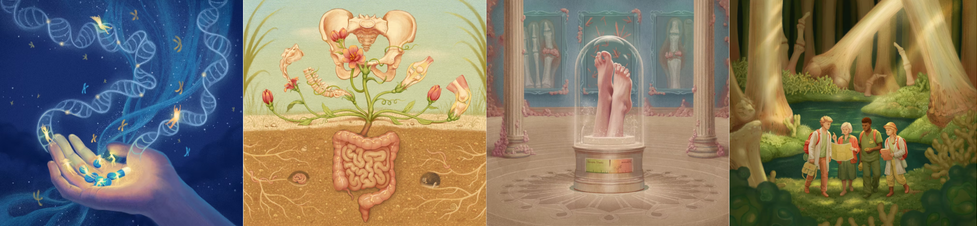
(Image source: Emma Cheng's Portfolio|The Lancet Rheumatology 2026 Covers)
In my illustrations, the body rarely behaves the way we expect it to. A brain might curl up with a book in a quiet room. An eye can become a camera. Bacteria turn into patterns people actually want to wear. Organs smile, wander, rest, or take over the scene with the calm confidence of characters who have been there all along.
That playfulness is part of what makes my work so approachable. I am a Taiwanese physician turned illustrator based in San Francisco, and I know anatomy from years of medical training. I also know how intimidating medicine can look from the outside. My instinct is not to make the subject less intelligent, but to give people a more inviting way in.
My work now spans editorial publishing, technical medical illustration, books, and healthcare collaborations. I have contributed medical illustrations to major medical textbooks, including the ninth edition of Shackelford's Surgery of the Alimentary Tract, while my broader client list includes The New York Times, Science, Bristol Myers Squibb, and DK. The Lancet selected me for two year-long cover series: twelve covers for The Lancet Rheumatology in 2026, followed by twelve for The Lancet Haematology in 2027.
On paper, my biography can sound almost tidy: doctor, designer, illustrator. In real life, the change took close to a decade. There were overlapping jobs, anxiety, false starts, a lot of self-teaching, and plenty of experiments that went nowhere. "There was no single aha moment," Emma says. “Some things flopped, some fell through, but every experience taught me something.”
Drawing Before Medicine
I have loved drawing for as long as I can remember. At five, she already wanted to be an artist. She doodled on textbooks, classmates' notebooks, even my sister's graduation album. Comics and cartoons kept feeding the urge to make things.
At home, though, art was not treated as a serious future. My father worried that drawing would distract me from academics so I learned to draw quietly and secretly.
Luckily - or maybe not - I did well in school.
When it was time to choose a university major, I did not yet have a clear sense of what she wanted. Medicine was respected, secure, and matched my test scores, so I entered Taipei Medical University and began what was then a seven-year medical program.
Moving to Taipei gave me more freedom than I had ever had at home. Medical school was demanding, but outside class I kept finding ways to make things: graphic design for the university library, an illustrated book funded by a school grant, hand-painted shoes and hats sold with my sister at a local market, even modeling in a hairstyling competition.
That experience really opened my eyes. I realized there are so many kinds of success, not just academic ones.
By graduation, I had received the university's Award for Excellence in Arts and Culture. I still became a doctor, but the possibility of another life had already taken root.
Leaving the Ladder
After graduation and my licensing exam, I entered residency training in Physical Medicine and Rehabilitation. For the first time, the future in front of me felt extremely clear - almost too clear.
I looked at senior doctors and saw a ladder: residency, attending physician, promotion, more responsibility. It was a stable path, and many people would have found that reassuring. I had the opposite reaction.
I started to see a very predictable future ahead of me. Honestly, I couldn't see any version of myself I wanted in my senior colleagues. I saw more of what I didn't want.
A short trip to the Netherlands made the feeling harder to ignore. I was struck by how much design seemed woven into everyday life - architecture, museums, visual culture, even ordinary objects. The trip did not magically give me a new career plan, but it made the contrast obvious. I wanted a life with more color, art, and creative freedom.
For months, I thought about leaving residency almost every day. Younger doctors often encouraged me to try. Older doctors were much more skeptical. Some told me I was being too romantic. Others asked the obvious question: how was I going to support myself?
I did not tell my parents at first because I knew they would try to stop me. The hardest part was not that I hated medicine. I didn't. I simply could not imagine giving up creativity for the rest of my life. I was also aware of my own perfectionism and how much pressure I put on myself when the stakes involved another person's health.
At twenty-eight, I decided to leave residency, beginning a transition that would unfold over the next several years.
I still remember telling one of my female supervisors. She looked at me, sighed, and the very next second, tears started rolling down her cheeks.. The depth of emotion in her eyes caught me off guard, and I started crying too. The two of us ended up hugging in the office, both in tears.
When my parents found out, they were furious. Our relationship remained tense for years.
I had expected the reaction, but it was still very difficult when it actually happened.
The Messy Middle
Leaving residency did not turn me into an illustrator overnight. I knew I wanted a more creative life, but I had no fixed idea what form it would take.
I began working in aesthetic medicine clinics, which gave me more flexibility and financial stability. To my surprise, I actually enjoyed the work. Aesthetic medicine involved beauty, proportion, observation, and careful hand skills - qualities that felt much closer to my creative interests than I had expected.
At the same time, I enrolled in design graduate programs and explored how medicine could connect with design. I no longer felt fully part of medicine, but I did not yet feel like a real designer or illustrator either. My parents wanted me to return to residency, and I was desperate to prove I had not made a terrible mistake. Around the same time, my seven-year romantic relationship ended, adding another layer of grief to a period already full of uncertainty.
I always feel that the very beginning was the darkest time in my life. I didn't know if the new path would actually be better. I didn't feel like I belonged in either world."
Eventually, graduate-school projects opened another door. A pill grinder I designed helped me earn an opportunity to study biomedical design at Stanford. The background that had sometimes made me feel odd - doctor plus designer - suddenly became the reason I stood out.
Stanford expanded both my professional and personal world. I worked around medical-device innovation and startups, explored user experience design, and met the man who later became my husband. I also encountered Designing Your Life, the Stanford d.school course and book by Bill Burnett and Dave Evans. Its approach gave me a way to think about life without expecting one perfect decision to solve everything. I liked it enough to facilitate a Life Design class for a quarter.
Meanwhile, illustration kept pulling me back. I had studied design partly because Taiwan did not really have illustration schools. But after years of exploring design, medical innovation, and other creative directions, I realized illustration was what I wanted most. I taught myself through books, online courses, practice, and endless observation. I continued working in aesthetic medicine while building a portfolio, sharing art online, and developing my own products and shop.
For several years, I lived both lives at once.
It was like dating two people again and again. At some point, you have to make a decision.
The final shift came in 2021, when I married and moved to the United States with my husband. I did not plan to continue practicing medicine in the U.S. Instead, I treated the move as permission to go all in on illustration.
Finding My Visual Language
I did not begin by deciding to make medicine a central part of my work. Early on, I drew all kinds of things - animals, plants, food, objects. But whenever I shared work related to medicine and anatomy, people responded differently. It made sense. Anatomy had been embedded in my visual memory for years.
Frank H. Netter's medical illustrations were especially formative. As a medical student, I studied those images closely enough that many of them became almost impossible to forget. Later, Ernst Haeckel's biological illustrations showed me another possibility: scientific images could be rigorous and beautiful at the same time.
Colored pencil became one of my favorite early media because of its texture and the slow gradients created by layering color. My work is often described as warm, but I didn't intentionally decide to make 'warm' art. I'm actually attracted to things that are quiet, mysterious, even a little strange or whimsical, and I interpret them in my own way."
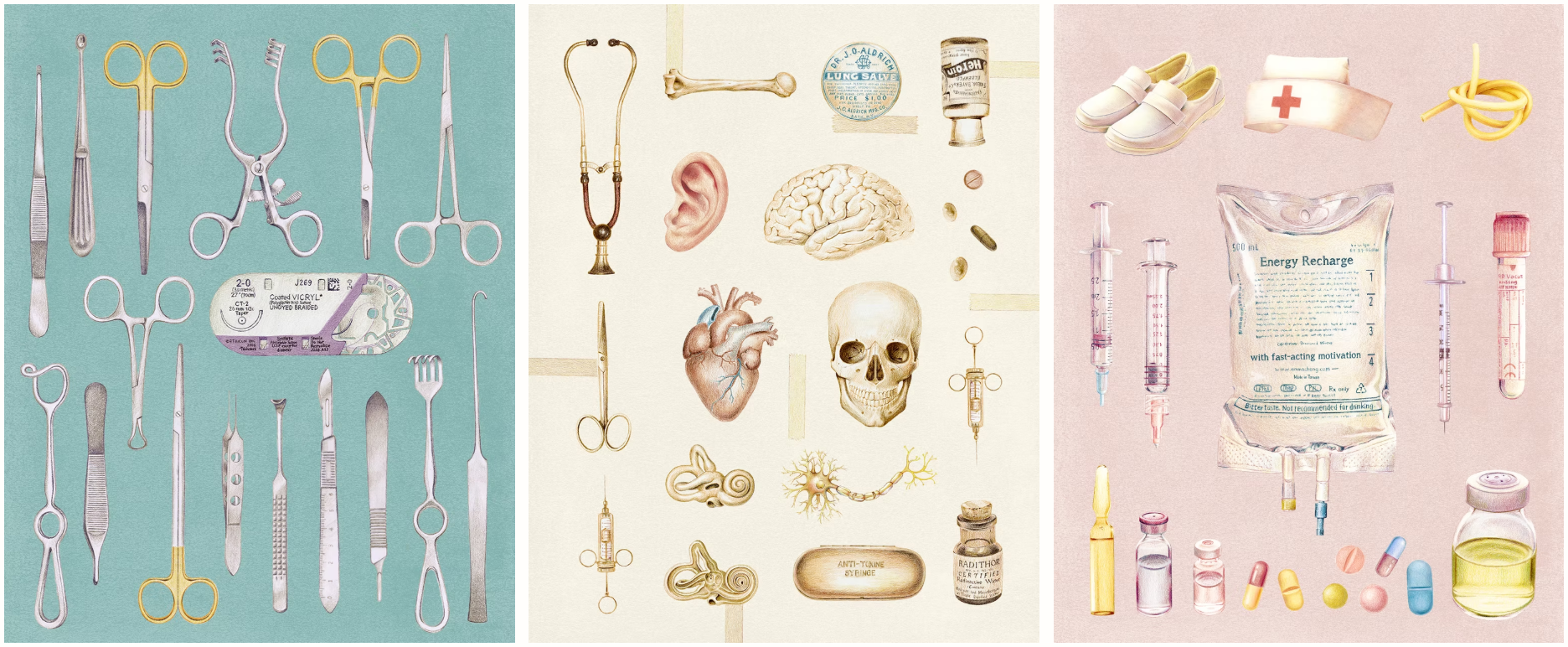
That combination - anatomical precision with softness, humor, fantasy, and sometimes a slightly surreal mood - became central to my work. My medical background also gives me unusual freedom in choosing what part of a subject to show. A health campaign does not have to feature a patient or a doctor. It might focus on alveoli, vessels, immune cells, a signaling pathway, or something microscopic most viewers never think about.
For a smoking-related image, for example, I drew cheerful alveoli rather than the more predictable cigarettes and smoke. I like finding those less obvious entry points. At the same time, I have learned not to assume that everyone recognizes anatomy the way a doctor does. Once, someone could not identify a kidney in one of my drawings. The moment stuck with me: medical professionals live with these shapes every day; most people do not.
My products push the same idea into daily life. Organ pins, stethoscope charms, bags, and bacteria-themed shirts turn medical imagery into objects people can wear or carry. The bacteria shirts became an unexpectedly big success. For me, it was proof that people will engage with science when it arrives in a form that feels personal, beautiful, or funny.
When Research Becomes an Image
As my career grew, the projects became more ambitious, but the part I enjoy most has stayed remarkably consistent: research, followed by the puzzle of turning information into one image.
My work for The Lancet makes that process especially visible. For each cover, I start with a paper or review and look for the mechanism, relationship, or tension that gives the research its shape. The final image is not a diagram of the paper; it is a visual metaphor built from it. For the January 2026 issue of The Lancet Rheumatology, a study on genetic susceptibility to IgG4-related disease became a loom: DNA acts as the source pattern, while immune cells, antibodies, and fibroblasts become part of a fabric that can go wrong when the instructions at the beginning are altered. For another cover, the gut-joint axis became a plant, with the intestine forming roots below the soil and joints growing above it.
That balance between accuracy and imagination is exactly where I like to work. The Lancet commission also became a major milestone: after winning two cover competitions, I was selected to create all twelve covers for The Lancet Rheumatology in 2026 and all twelve for The Lancet Haematology in 2027.
A very different publishing project asked for a different kind of sensitivity. For DK's Doctor, I've Found a Lump, I created a cover for a book tracing decades of progress in breast cancer medicine. The brief called for breast anatomy to be woven into flowers and leaves - recognizable enough to carry the medical subject, but gentle enough that the cover did not feel clinical or frightening. It is the kind of problem that suits me: the science has to be there, but so does the emotional experience of the reader picking up the book.
My recent illustration for Science magazine's Fall Books 2026 round-up pushed me in yet another direction. The assignment brought together nine books spanning very different subjects, with only a few obvious connections between them. I researched each one, pulled out distinctive characters, objects, and visual clues, then built them into a single surreal landscape. A slime mold reaches out with a capsule representing the nocebo effect; a grizzly bear tests a supposedly bear-resistant cooler; an aurora glows over Antarctica. The fun of the image comes from seeing unrelated ideas somehow share the same world.
Researching the books felt like stepping into a different sci-fi film or documentary with each one.
Each assignment sends me into a different subject, and the research can easily turn into a rabbit hole - a part of the work I enjoy.
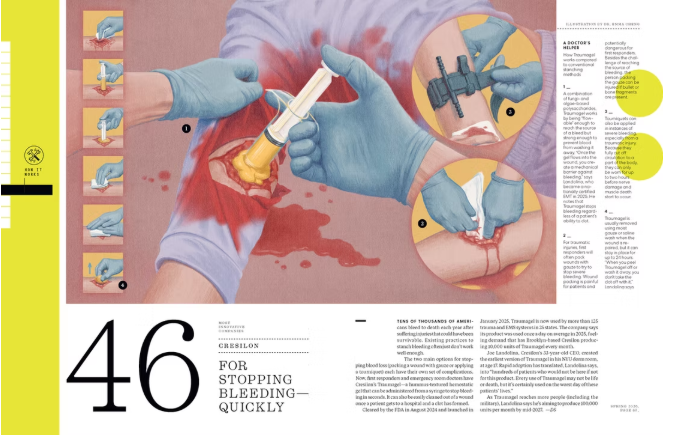
Technical medical illustration asks something different of me. Here, metaphor gives way to anatomical accuracy and clarity. I have been drawn to this kind of work since medical school, when I often wished textbooks contained images that were not only accurate, but also beautiful and easy to understand. To me, good medical illustration should make difficult material easier to absorb and the experience of learning more enjoyable.
I have contributed medical illustrations to medical textbooks, including the ninth edition of Shackelford's Surgery of the Alimentary Tract, a longstanding reference in gastrointestinal surgery. For one chapter, I created illustrations of anorectal surgical procedures, translating complex operative anatomy into images that needed to be both precise and immediately readable.
A project involving fibroadipose vascular anomaly, or FAVA, required a different kind of problem-solving. I reviewed medical literature and consulted specialists to determine which structures needed to be shown. Surgical photographs can be visually noisy, so I may study meat for tissue texture or branching plants for blood vessels, looking for ways to make the image more visually appealing and readable without compromising anatomical accuracy.
For me, that is the appeal of technical medical illustration: finding a balance between accuracy, clarity, and visual appeal, so that even complex medical subjects can feel more welcoming to the reader.
Learning the Industry From Scratch
When I moved to the United States and became a full-time illustrator, I had no network in the American illustration industry. I had never gone to illustration school and did not personally know art directors. So I did what I often do when I do not know how something works: I researched it.
I contacted illustrators I admired and asked for advice. They told me to build a strong portfolio website and start emailing art directors directly. Later, a mentorship with The Illustration Department helped me understand the industry more clearly.
At first, my outreach rarely led to an immediate response.
My first major project came from Harvard Public Health about five months after I had emailed an art director there. The response arrived so long after the original message that it felt almost random. My first New York Times job also came after direct outreach, but only after I had contacted several art directors at the publication.
Most emails don't get replies. That doesn't necessarily mean nobody looked at your work.
While waiting, I kept creating work that reflected the projects I hoped to attract. Social media helped early on, but I learned that a strong portfolio mattered more than follower count.
Over time, those efforts widened into a career that now spans editorial publishing, medical and pharmaceutical work, books, products, and brand collaborations. Medicine and art have never been completely separate in my career: my medical background still shapes many of the subjects, clients, and questions that find their way into my work. Recognition from the Society of Illustrators, Communication Arts, American Illustration, 3x3, and the World Illustration Awards helped put my work in front of more people.
Learning Not to Work Like a Doctor
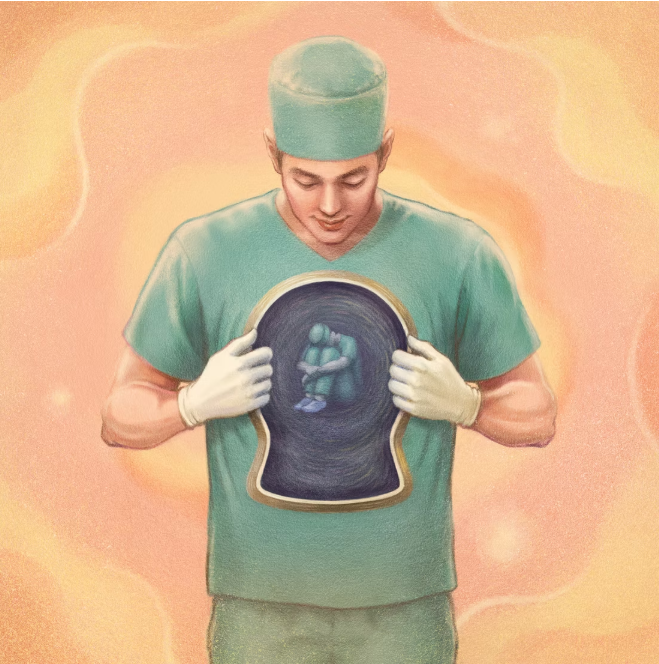
One of my harder lessons was realizing that the work habits rewarded in medicine could be terrible for an artist.
For years, I treated illustration in "doctor mode." I pushed through exhaustion, obsessed over details, and assumed working harder was always the answer. At the same time, I was still treating patients in aesthetic clinics. Both jobs depended heavily on my right hand.
Eventually, my right shoulder, arm, and fingers became chronically stiff and painful. The problem improved only after I became a full-time illustrator and began taking my own health more seriously.
Health has been the core value in both of my careers, but it was only after becoming a full-time illustrator that I really learned how to take care of myself.
I am also trying to loosen perfectionism. As a doctor, obsessing over details can be appropriate; mistakes can have serious consequences. In art, that same instinct can make it impossible to finish anything. I have learned that not every part of an illustration needs equal detail.
My current routine is flexible rather than rigid. I keep a few large goals - client work, products, improving her skills, outreach, and social media - then break them into smaller tasks. Priorities move around depending on deadlines.
It's kind of like juggling. You keep catching and tossing whatever ball is coming down next.
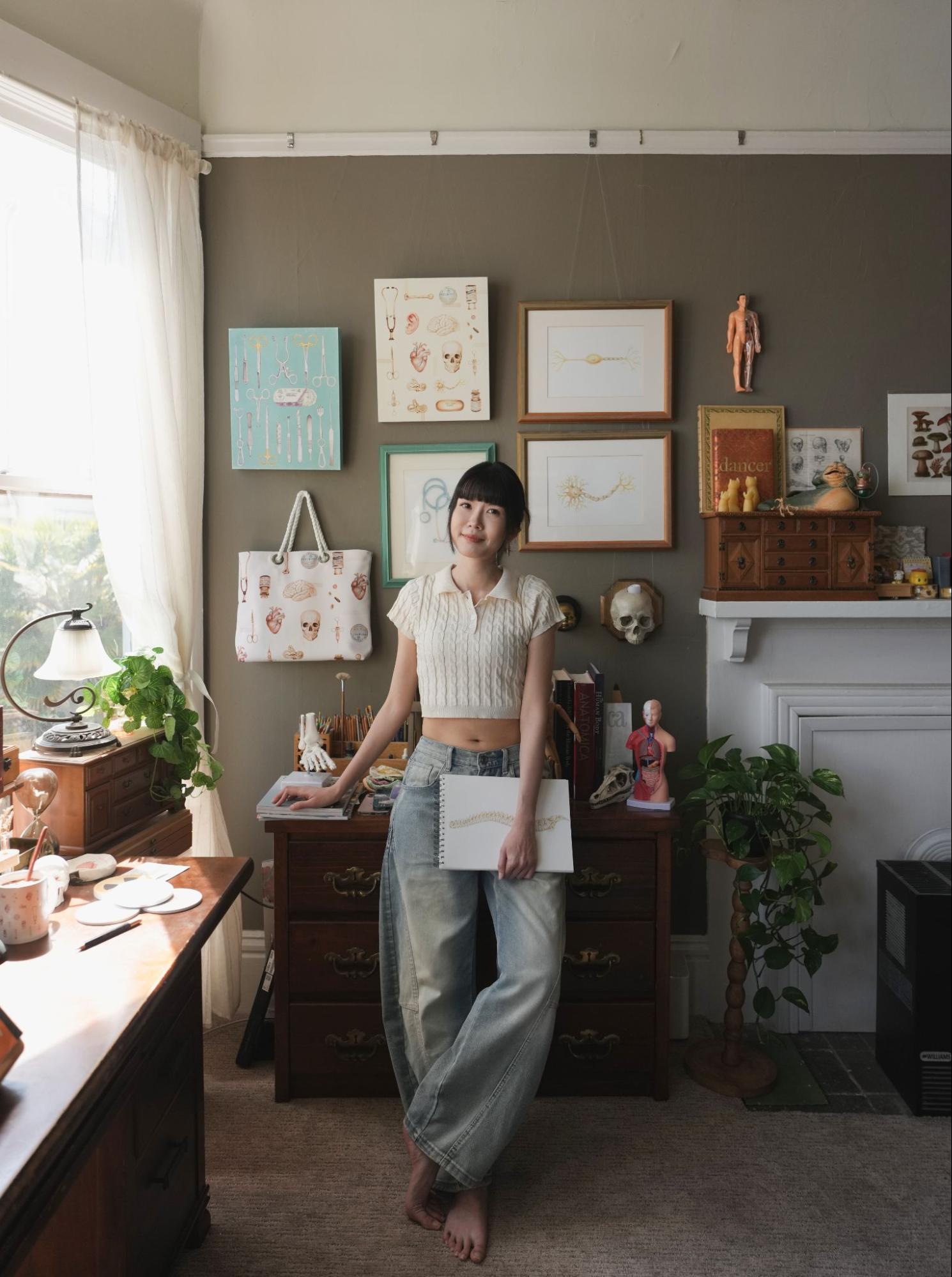
My San Francisco studio is part of that new life. It sits in a Victorian-style building, filled with vintage lamps, carved chairs, old jewelry boxes, scientific books, medical figurines, and anatomical models. Test tubes and flasks hold styluses and art tools. Warm sunlight comes through the windows, and walks around the city often reset my attention when I have been working too long.
Honestly, one reason I wanted to be an artist was to live in an artsy space. Building my own stylish studio is part of that dream. It's probably a lifelong project.
Building My Own Ladder
My career change was never really about throwing one identity away and replacing it with another. It was about finding a place where the parts finally made sense together.
I know how messy it was. Clinic work gave me financial support. Design school and Stanford gave me room to experiment. Other artists helped me understand the industry. Moving to the U.S. gave me a natural moment to start again. I kept trying things until I could tell the difference between what looked good from the outside and what actually felt right to me.
Years ago, medicine offered me a ladder that had already been built. All I had to do was keep climbing. Illustration was the opposite. There was no fixed route, no exam that unlocked the next level, and no guarantee that the next step would work.
More than a decade after leaving residency, I am still building the ladder myself. I think I prefer a life that is not that predictable.


