
A Ticket, a Bento Box, a Journey: Women in the Railroad Industry


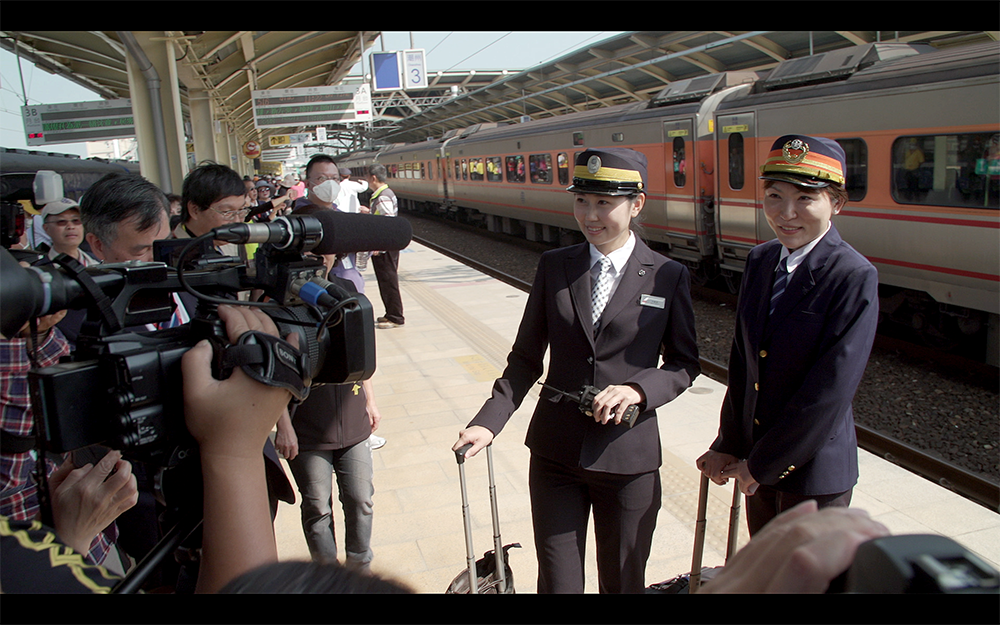
With a ticket and bento box in hand, we are going on a journey. And, of course, you are invited to join us!
It was a Wednesday when I suddenly had the urge to take the train to Fulong Beach where I could spend the day pretending to be a hip young girl. So, off I went to Taipei Main Station to buy a train ticket. I wasn't sure just how long I could keep up my farce, so when the saleswoman asked me if I wanted to buy a roundtrip ticket, I politely declined.
These days, Taipei Main Station no longer has someone punching tickets at the entrance to the platform. (Oh how I wanted one of those ticket punches when I was younger!) And, once in the station, it wasn't long before I boarded the train.
Leaving Taipei we entered an underground section of tracks, at the end of which the crystal blue ocean appeared. "Thank you for travelling with us,” announced the intercom as an attendant pushing a service cart came down the aisle. “We will now begin selling lunch bento boxes. Today's meal comes from the Qidu Station cafeteria."
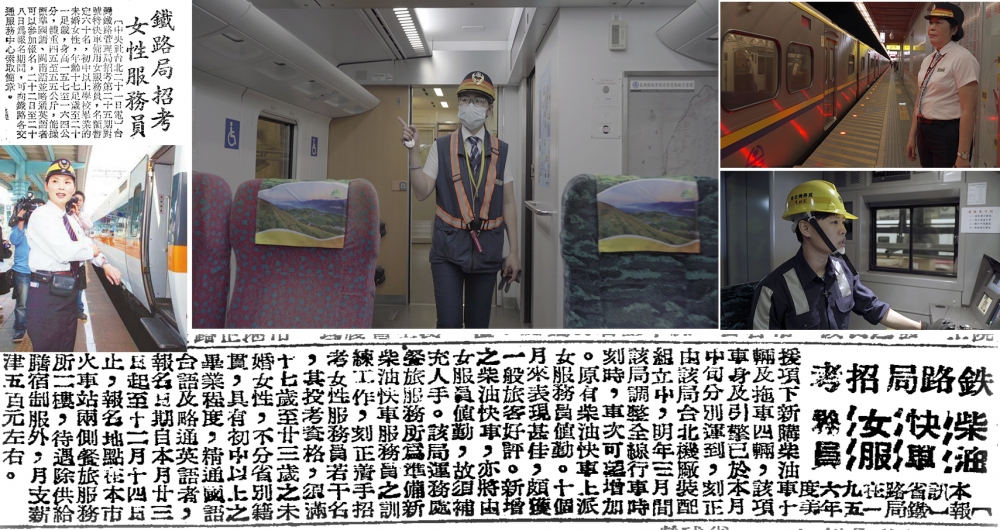
A reference to women of the railways often brings to mind so-called sightseeing train stewardesses or express train stewardesses, though the correct term these days should be train attendant. Many years ago, the recruitment process for these positions in Taiwan Railways included rather ridiculous standards: an attendant needed to be unmarried, between the age of 18-21, 158-165cm (5'2-5'5) in height, and 45-58kg (99-128lb) in weight.
“The interview process was almost like a beauty pageant,” one attendant who had worked for Taiwan Railways between 1970-1980 told us. “After a few basic questions, we were asked to walk for the interviewers to evaluate.” This recruitment process for Taiwan Railways was, at the time, considered “the strictest” after that of female flight attendants. It wasn’t just Taiwan Railways that took notice either, some former attendants even said that “many business owners (or their mothers) would take the train to look for a wife.”
But with the implementation of Taiwan’s Employment Service Act, Gender Equity Education Act, and Labor Standards Act came better understanding of gender equity, and, with it, phasing out of these outdated standards.
Few and Far Between
It wasn't long before our documentary research drew us into discussions about women as station mistresses, female train drivers, or female locomotive inspectors. However, historically, these women technicians or in upper management positions were few and far between.
It wasn’t until 2012 that Taiwan Railways announced its first female driver after a hundred years of operation. Ever since, news headlines of a station’s first female locomotive inspector or station mistress sing praises of how the woman was determined to overcome all hurdles. These pieces, however, also touch on the criticism the women experienced over the years. Frequent comments such as “You won’t last. You’ll be gone soon enough,” haunted even the first female driver after ten years of service.
So just how rare is it to have women in these positions these days? According to statistics from 2019, of the 1,364 drivers employed by Taiwan Railways, 13 were women and there were an additional three in training. This is a ratio of 99 men to every woman.
Then why do these male drivers not receive the same attention as their female counterparts? Do they not have to work as hard? Is their training not as demanding? Or do they not need to expend as much focus and attention to detail in order to be responsible for the safety of hundreds, even thousands, of passengers? This treatment seems rather unfair to the majority of drivers, stationmasters, or inspectors.
Workplace Struggles
As we worked on this documentary over the past year, we often heard various explanations for the gender imbalance such as: “Jobs in the railroad industry have long been dominated by men because they are labor intensive and require professional training.” However, this explanation seems to imply that all jobs on the railways require extensive experience, technical skills, or physical strength.
In truth, the railroad industry does not only require people to run the trains, it requires people to provide services. Though there many jobs were long considered "not suitable" for women (such as train drivers, maintenance technicians etc.), women still processed paperwork in back offices, sold train tickets, and provided services to passengers on the train. These women have rarely been recognized for their contributions, or if they have been it has been in a degrading way.
It is only recently that a small number of women have been able to become railway inspectors, enter management positions, become drivers, or serve as maintenance technicians. These women are often highlighted by the media as symbols of progress, signifying not only that Taiwan Railways has begun to address gender issues at an organizational level but also that these issues are still prevalent throughout society.
The False Dilemma of Choosing between Work and Family
In our time documenting these women, we heard some heartbreaking stories. But some of these stories allowed us to ask important questions. One such story was that of a train station announcer. It used to be that station announcers were on duty for 24-hour shifts, meaning that if you started work at 8 AM today, you would get off work at 8 AM tomorrow. As a result, many women would sometimes bring their children with them to work or felt forced to resign because they worried about their family obligations.
These stories, however, raised more questions such as: Why didn't men have to worry about taking overnight shifts or taking care of their families? But the real question, we discovered, was: Why a 24-hour shift? Our initial reaction to what seemed like a gender-related issue actually led us to ask a broader question not limited by gender.
Ultimately, the gendered history of the railway industry provides significant insights into the attitudes of each generation. Women, when faced with limited options, had to construct their own methods to meet societal expectations.
My journey was interrupted as the train intercom sounded once more: "Passengers for the 13:00 Tze-Chiang train to Kaohsiung should head to platform one. The train will soon depart."
A ticket, a bento box, a journey. Next time you take the train, take a moment to think about how many people, no matter their gender, have dedicated themselves to their work so that us passengers are able to enjoy the passing scenery and safely reach our destinations.
編輯推薦:
國家鐵道博物館籌備處[2021台灣鐵道產業女性紀實]影片共8支


